Bedding · Materials Guide
Inside Naturepedic’s Muslin Duvet Cover: What an Open Weave Changes
A duvet cover is a modest piece of architecture: a fabric envelope, a fastener, a layer between the sleeper and the filling. Yet its weave can change how the bed looks, feels, and moves air. Muslin makes a case for softness without polish—and for a kind of luxury that leaves a little room for the imperfect.
Published November 2, 2026
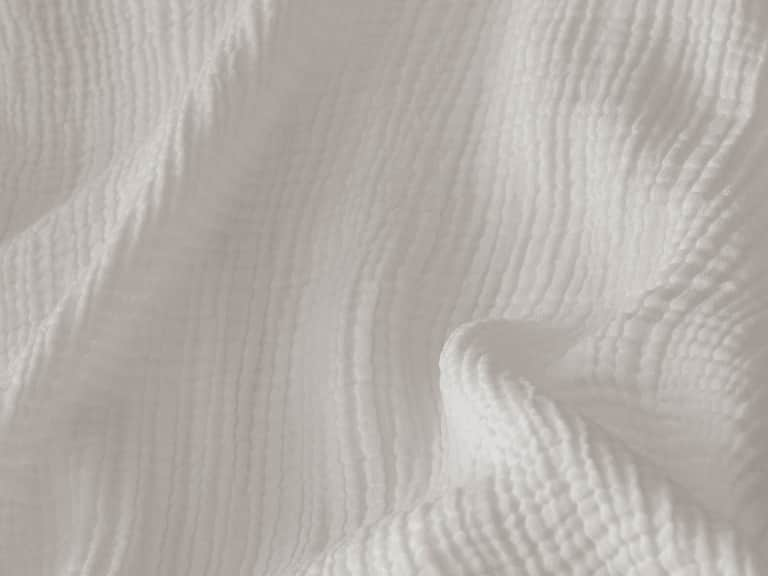
There are beds that seem to have been made for a photograph, every corner pulled into a strict right angle, every surface smooth enough to reflect the light. Then there are beds that look as though someone has just left them, perhaps to answer the door or put the kettle on. A muslin duvet cover belongs more naturally to the second kind. Its gently puckered surface resists the tyranny of the perfectly flat sheet. It offers texture where sateen offers sheen, and a relaxed softness where a close, crisp weave makes a more formal impression.
That difference is not merely decorative. How a fabric is woven affects its hand, weight, drape, and capacity to exchange air with the layers beneath it. Those qualities, in turn, shape the small nightly negotiations between a sleeper, a duvet, and the room: whether the cover feels cool or warm at first touch; whether it falls close to the body or floats a little above it; whether the bed feels crisp, yielding, or faintly rumpled.
Naturepedic’s organic cotton muslin duvet cover provides a useful example. Its construction is described as breathable, lightweight, and pre-washed, with a relaxed, crinkled texture. Those details point to a particular idea of comfort—one built less around a sleek finish than around airflow, softness, and a lived-in appearance. The appeal is easy to understand. The question is whether that appeal suits the person who will sleep under it.
What “open weave” means in practice
Weave is the arrangement of threads crossing one another. In a plain weave, threads pass over and under in a simple, regular pattern. Other constructions can make the surface more lustrous, more compact, or more textured. The phrase open weave describes a fabric structure that leaves relatively more space between yarns than a very dense construction might. It is not, by itself, a precise technical specification: yarn size, finishing, and the tightness of the weave all matter. But as a general description, it helps explain why muslin often feels light and airy.
Air can move through a textile to varying degrees, although no duvet cover works alone as a temperature-control system. The duvet insert, the mattress, the room temperature, sleepwear, and a person’s own tendency to feel warm or cool all have a part to play. Still, a lighter cover can feel less enclosing than a heavy, dense one. The effect may be subtle rather than dramatic, but subtlety is often the scale at which bedding does its work. We notice it when we turn over, pull the cover up, or wake in the night and find the bed has become too warm.
Muslin’s openness should not be confused with a guarantee that a sleeper will remain cool in every circumstance. A thick duvet inside any cover can retain warmth; a warm bedroom can overwhelm the benefits of a breathable fabric. The more useful claim is modest: a lightweight cotton cover with an airy construction may feel less stifling than a heavier, more tightly woven alternative, depending on the rest of the bed and the person using it.
Texture, and the pleasure of not ironing
Muslin’s texture is part of its appeal. The surface is gently crinkled, not in the accidental way of a sheet abandoned in the dryer, but as a quality of the cloth itself. It catches light unevenly and gives a bed a quiet, informal depth. In a room dominated by smooth finishes—painted walls, polished wood, glass, metal—that small irregularity can soften the whole composition.
There is also a tactile distinction. A smooth sateen cover tends to glide beneath the hand. Percale is often associated with a crisp, dry feel. Muslin, by contrast, may feel soft and airy, with a little more surface character. No one description can settle the matter for every sleeper; fabrics are experienced by skin, not by adjectives. A person who likes the cool, taut feel of freshly laundered percale may find muslin too relaxed. Someone who dislikes a slick finish may appreciate its gentle texture.
Pre-washing can contribute to that soft, settled hand from the beginning, though the exact feel changes with laundering and use. The crinkle is not necessarily a flaw to be removed. Pressing the fabric flat may work against the look that makes it distinctive. For those who prefer a bedroom that appears composed but not ceremonious, this is a practical kindness: the cover need not be treated as a piece of upholstery that must remain immaculate.
That does not mean every wrinkle is charming, or that a rumpled bed is automatically a well-designed one. It means the material has a visual grammar of its own. Muslin tends to make a bed look softer and less formal. A smooth, densely woven cover can make the same room feel sharper, more tailored. These are not competing standards of taste so much as different moods.
Cotton, breathability, and the limits of labels
Cotton is familiar enough to seem self-explanatory, but the word alone says little about how a particular cover will feel. Fiber quality, yarn construction, weave, finishing, and weight all contribute. Two cotton textiles can have very different characters: one crisp and close, another soft and open, another brushed or lustrous. “Organic cotton” describes how the cotton is grown and certified under the relevant standard; it does not, by itself, tell a shopper whether the fabric will feel cool, silky, or substantial.
The Naturepedic cover is described as made from GOTS-certified organic cotton. That certification is relevant to readers who prioritize standards governing organic fibers and processing. It should be understood as information about the product’s certification, not as a promise that a particular textile will improve sleep or suit every skin sensitivity. Comfort remains personal, and people with specific allergies or dermatological concerns may need guidance from a qualified clinician.
Likewise, “breathable” is a useful but broad word. It points to a fabric’s capacity to allow air and moisture vapor to pass through, but it is not a single universal measure of performance. A cover’s practical effect depends on its full construction and on the duvet inside it. A lightweight muslin shell over a lofty, warm insert may produce a very different night from the same shell over a thin summer fill. Layering is the system; the cover is one of its parts.
A cover is not the duvet inside it
The distinction sounds obvious until it is obscured by the way bedding is sold. A duvet cover is the removable textile casing. The insert—down, wool, cotton, synthetic fill, or another material—provides most of the insulation and loft. The cover changes the first touch, the drape, and the interface with the insert; it does not transform a heavy winter duvet into a summer blanket simply by being woven more openly.
For someone who sleeps warm, this suggests a sensible order of decisions. First consider the duvet’s warmth and fill. Then consider room conditions and whether the bed has too many layers. Finally, choose a cover whose weight and feel complement the arrangement. A breathable cover may contribute to a less clammy-feeling bed, but it cannot compensate for an insert that is much too warm for the season.
For someone who sleeps cool, a muslin cover can still make sense. The fabric’s lightness does not prevent the duvet from providing insulation. The relevant question is whether the preferred sensation is a soft, airy shell or a denser layer that feels more enveloping. Temperature regulation is not a contest in which the lightest fabric always wins; it is a matter of matching the whole bedding ensemble to the sleeper.
How to layer muslin without losing its character
Muslin’s relaxed surface works particularly well when the rest of the bed does not try too hard. A simple fitted sheet, a pair of pillows in a complementary fabric, and the duvet cover itself may be enough. If additional warmth is needed, a light blanket can be folded at the foot of the bed rather than trapped between multiple heavy layers. This makes it easier to adjust the bed during the night and preserves the cover’s loose drape.
Color can either emphasize or quiet the texture. Pale neutrals tend to reveal the play of light across the crinkles, while deeper shades make the surface read as a more continuous field. Pattern is possible, but a strongly patterned room may compete with muslin’s own irregularity. The aim need not be a carefully staged bedroom. It may simply be to let one tactile element do its work without asking it to perform several jobs at once.
It is worth checking practical details before choosing a cover. Confirm that the size matches the duvet insert; an oversized cover can allow the insert to migrate, while a tight one may compress its loft. Look for the closure type and any interior ties intended to secure the corners. A cover that is easy to remove is more likely to be washed on a sensible schedule. These unglamorous considerations have a disproportionate influence on whether bedding remains pleasant to use.
Laundering and the long life of a fabric
Care instructions should always take priority over general advice, especially when a product has specific requirements. Naturepedic describes this duvet cover as machine washable and pre-washed. In ordinary cotton care, washing with like colors and using a moderate temperature can help limit unnecessary wear, while harsh treatment and excessive heat may stress fibers over time. The label, however, is the final authority for that particular cover.
Because muslin’s crinkled appearance is intentional, there may be little reason to pursue a pressed finish. Letting it retain its texture can simplify care and preserve the look that distinguishes it from smoother bedding. Drying methods influence both feel and longevity; high heat can be hard on cotton, while a gentler approach may help fabric remain supple. A cover should be fully dry before it is stored or placed back on the duvet, since trapped moisture can create an unpleasant environment for textiles.
Frequent washing is not always a sign of better care. The useful routine depends on household habits, climate, pets, and personal preference. A removable cover is valuable precisely because it can be cleaned more easily than the duvet insert, but it still benefits from measured handling. Treating a textile as durable does not mean treating it as indestructible.
Who may enjoy muslin—and who may not
A muslin duvet cover may appeal to someone who likes a soft, casual bed, prefers a fabric with visible texture, or wants a lighter-feeling layer over a duvet. It may also suit a room whose design leans toward natural materials and an unforced, lived-in atmosphere. Its relaxed look can be an advantage in a home where the bed is used rather than merely presented.
It may be less appealing to someone who wants a smooth, crisp surface, a highly polished appearance, or the substantial hand of a denser fabric. Sleepers who are particularly sensitive to texture should consider that preference directly. The word “soft” is not a universal verdict: one person’s comforting softness is another’s distracting unevenness. If possible, assess comparable fabric samples in person, or buy from a source with a clear return policy.
Thread count alone will not resolve the choice. It is a measure associated with the number of threads in a defined area, but it does not independently determine quality, breathability, or comfort. Fiber, yarn, weave, finishing, and construction remain essential. For a muslin duvet cover, the more useful questions are concrete: Does the fabric feel right against the hand? Is the weight appropriate? Does its care routine fit the household? Does the texture appeal after a few minutes, not just at first glance?
A useful way to think about luxury
Luxury in bedding is often made to sound like a matter of polish: higher sheen, greater density, more elaborate stitching. But comfort does not always arrive in formal dress. It can come from a cover that breathes easily, a fabric that does not demand ironing, or a surface that grows more familiar with use. A relaxed material can be luxurious not because it announces its expense, but because it makes ordinary routines feel easier and more considered.
Naturepedic’s organic cotton muslin duvet cover sits within that quieter definition. Its stated features—an open, breathable weave, pre-washed softness, a crinkled finish, and machine-washable care—describe a coherent set of priorities. It is not a universal answer to overheating, nor a substitute for selecting the right duvet insert. It is an option for readers who value lightness and texture and who prefer a bed that looks at ease rather than meticulously pressed.
For a closer look at the listed construction and care details, see the Naturepedic Organic Cotton Breathable Muslin Duvet Cover. The most useful test, when choosing any duvet cover, is not whether its description contains the right luxury vocabulary. It is whether the fabric suits the way you sleep, the climate of the room, and the level of fuss you are willing to accept on laundry day.
A short checklist before choosing
- Consider the whole bedding system. The duvet insert and room temperature often matter more to warmth than the cover alone.
- Choose by hand feel. Muslin’s crinkle is a feature, not a defect; it suits some preferences and not others.
- Check fit and construction. Match the cover to the insert’s dimensions and review the closure and corner ties.
- Read the care label. A washable cover is convenient, but the specific washing and drying instructions still matter.
- Look beyond a single number. Fiber, weave, finishing, and weight together describe a fabric more clearly than thread count alone.
- Keep expectations proportionate. Breathability can influence how a cover feels, but no textile guarantees a particular sleep outcome.
The bed is a small climate, and its materials are part of the weather. Muslin does not command that climate so much as make it feel less sealed: a little more air, a little more texture, a little less insistence on perfection. For the right sleeper, that is not an incidental detail. It is the whole point.